Djabugay Bulmba
(Djabugay country)
Our country
Din Din
Din Din, also known as Barron Falls, is one of the largest falls in the Barron Gorge National Park. This place is special to our people because it tells the story of Buda:dji, the carpet snake that came slithering through the Barron Gorge, creating the shape of its body in the landscape. Our people have held Native Title determination for Barron Falls National Park since 2004. We’re one of the first peoples to be recognised in this way.
Mayila
Mayila is also known as Robb’s monument. John Robb was a contractor who built the railway line between 1886 and 1891. There were previously two large identical rocks, but one was blasted by dynamite during the railway construction. In our culture, people from the Gurra-Bana (wet-side) moiety are supposed to marry someone from the Gurra-Minya (dry-side) moiety. This story tells of how two people from the Gurra-Bana moiety breached this by secretly marrying. Our story time god Bulurru turned them into stones as punishment.
Walaara
Walaara, also called Surprise Creek, holds the story of the three greedy birds. They ambushed Buda:dji near the falls, trying to steal the shells he was carrying to the people in the mountains. These shells called Mia Mia, also known as nautilus shells, were very valuable to our people through trading times. The birds set a trap to steal the shells from him, using their stone axes to separate his body. Now his body is scattered all over the country. His head is at Grant Hill near Yarrabah and his body is up in the Tablelands. The birds were never seen again. His resting place today is on Wangal Djunggay or Double Island where ceremonies were held to commemorate him. Our neighbouring tribal groups have similar stories in his honour.
Guri- Guri Bunda
Guri- Guri Bunda, is known today as Red Peak. Walking trails from the peak led down towards Smithfield and Lake Placid, to the suburb now called Kamerunga. This area has a strong presence we call Wawu-Barra meaning ‘the spirits of the rainforest are still alive today’.
Bunda:rra Bunda
Bunda:rra Bunda, now called Macalister Range, holds the story of the Cassowary our sacred bird and symbol of the Djabuganydji people of the wet tropics. It protects the rainforest and is the guardian that gives life to the world’s oldest rainforest that is Djabugay country.
Mirrimbal
Mirrimbal is the Djabugay headdress made from the cockatoo’s crest. This type of headdress is unique to the area. The men would use these headdresses in men’s ceremonies. The area that resembles the Mirrimbal is known today as Glacier Rock. The white shaded escarpment you can see in the ridge of the mountain, is the head of the headdress that Damarri, one of the story water brothers once wore.
Bulmba Birrbi – Barra
Bulmba Birrbi – Barra was once the Djabugay fighting ground. When our warriors had disputes, they would settle this on the island near Lake Placid. This is one of a few places still recognised today.
Garrndal Garrndal
Garrndal Garrndal is now known as Stoney Creek. This place has the original walking tracks, which are still used by many people today. These tracks lead to our local community called Speewah. Djabugay people would use this route to travel between Cairns and the Tablelands for trading purposes.
Diwunga
Diwunga, known today as Stoney Creek Falls, means ‘slippery’ in our language. Diwunga connects with Garrndal Garrndal – Stoney Creek. Our people had camps at the top of the falls and would harvest Black Pine nuts. They harvested the nuts seasonally and placed them in water for days, leaching the toxins out before eating them. The nuts are full of protein but are highly toxic if eaten without being processed.
Bunda: Burrawungal
Bunda: Burrawungal, also known as Water Fairy Mountain, sits below Glacier Rock. It tells the story of how a man caught his first water fairy (similar to a mermaid) from the water in this area and wanted to make her his wife. He rubbed sand on his hands to catch her because the water fairies were very slippery, like an eel. He waited patiently until she arose from the water then grabbed her and put her near the fire so he could wipe the slime off her with a stick. Later, forgetting she was from the water, he asked her to get some water from the river, which she did, and never returned. She’s still there in spirit today.
Damarri Bunda
Damarri Bunda is a story of a Djabugay legend known as Damarri. He was a big man that gave the crocodile its first teeth. He made the teeth from the mangroves near a place called Bida: where the mouth of the Barron River meets the lower Freshwater Creek. He shaped the teeth, making them sharp to fit the inside of the crocodile’s mouth. Back then we believed that crocodiles were toothless. One day the crocodile was hungry, so Damarri let him bite his calf muscle. This was the first time the crocodile ate human flesh. Damarri sang out ‘Yagay!’ meaning ouch! Damarri fell ill after the bite and lost a lot of blood. Hethen crawled to his resting place now known as Redlynch Mountain.
Ngunbay
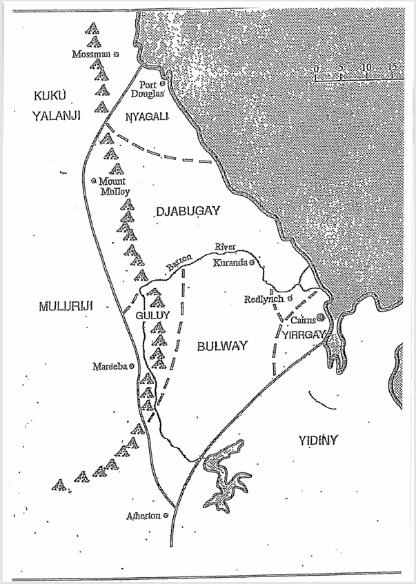
Ngunbay, also known as Kuranda, means ‘place of the Platypus’. Kuranda was a meeting place where many ceremonies were held for all Djabugay groups, including the Bulway, Yirrgay, Guluy, and Nyagali speaking people. All these groups spoke one ngirrma (language) and had their own dialect, but each group could understand each other. Today, Kuranda is home to all tribal groups, and we have a strong connection to this country through family ties.
Wangal Djunggay
Wangal Djunggay, also known as Double Island, means the ‘running boomerang’ and is the home of the carpet snake. Our people held big corroborees with neighbouring groups such as Gungganydji people from Yarrabah. The story of the island is that a little boy flew over Djabugay country as a boomerang, naming all the places significant to our heritage. Once finished he landed on the middle of the island making the shape of the boomerang you see today. This story honours the memory of him and the carpet snake.